

Access Equipment: Types and Tips for Choosing
Accidents at the workplace can happen at any time, but some professions and settings are more at risk than others – especially those that involve working at heights two meters or more off the ground. According to the latest Key WHS Statistics report, falling from a height accounts to 13% of all workplace fatalities in Australia. While it may be lower compared to previous years, it’s still a big concern that should be addressed promptly.
Warehouse and industrial environments where you get to do storage, material handling and machine maintenance aren’t the only examples we have here. Window washing, steel working, HVAC servicing, logistics, wall painting, construction working, tree trimming, crane installing, power line working are some of the others on the list as well.
While each of these is different, they have one thing in common – aside from the necessity for adequate height training with a nationally recognised Work Safely at Heights – RIIWHS204E course for every employee, they require the use of reliable access equipment. This comes at the forefront when planning on cutting down the risks of falls and injuries and ensuring a comfortable work environment that enables efficiency and productivity.
What is Access Equipment?
Basically, it’s any tool, machinery or platform designed for safe and efficient work at heights. As implied by the name, its main purpose is to provide the workers with easy and safe access to otherwise hard-to-reach elevated areas.
In addition to the convenience, investing in this type of workplace access equipment helps meet regulations enforced by Safe Work Australia, avoiding fines and legal actions. An added benefit is that it minimises the risk of safety issues that come from repetitive strain injuries with manual handling tasks by offering the needed support for the tasks.
Types of Access Equipment Available
If you’re wondering what types of access equipment are available at the specialised suppliers, or are trying to understand more about the different options to make the shopping hassle-free, the following listing can provide you with some assistance.
Ground Support Equipment
This is one of the basics of industrial and warehouse access equipment because it’s essential for creating a stable work environment, providing the safe ground-level access to elevated areas, machines, and structures. This includes simple to complex options, such as:
- Steps and stools – When it comes to tasks at lower heights, you don’t need access equipment for sale that’s higher than steps and stools. Here you have two options: the compact and lightweight kick steps with retractable caster wheels for mobility and locking property when stepped on, and the step stools which can be both foldable or fixed with one to three flat steps. Both options are great for tasks that don’t require long height access.
- Platforms – From maintenance and work platforms to specialist access platforms you can use over desks or structures like roofing, and into machines, these flat and stable surfaces with height adjustability provide the space and support needed for inspection work, maintenance and repairs.
- Ramps – Available as loading and container ramps for forklifts and pallets, they’re made to provide access to these equipment essentials, offering smooth transition from the ground up to the container or forklift, reducing the manual lifting need in areas like docks and warehouses.
- Forklift safety cages – With safety features such as high guardrails, non-slip floor and an anchor for using a safety harness, they offer a secure attachment to elevated forklift work areas. It’s a more secure solution than ladders and stools for higher work areas, and is a practical and time-saving alternative to scaffolding for quicker tasks.
Vertical Access Equipment
Unlike ground access equipment for warehouses and industrial sites that provides access from the ground up, the vertical alternative is designed to move vertically, up and down. This way you can work between levels wherever needed, with the help of:
- Swing stages – With suspended platforms you get to operate at the push of a button, you can move up and down with hoist cables with ease.
- Lifts and elevators – When moving a great amount of equipment, goods, or personnel across different plants or areas, you need all the safety you can get, which calls for the use of hydraulic lifts (e.g. scissor and mast) and freight elevators.
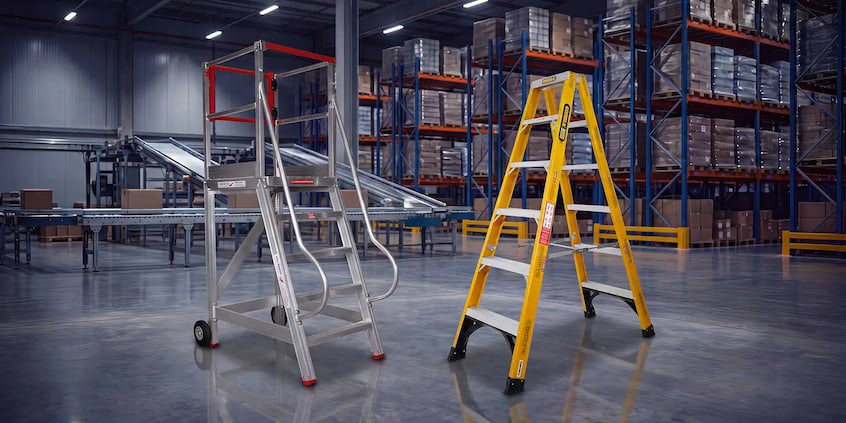
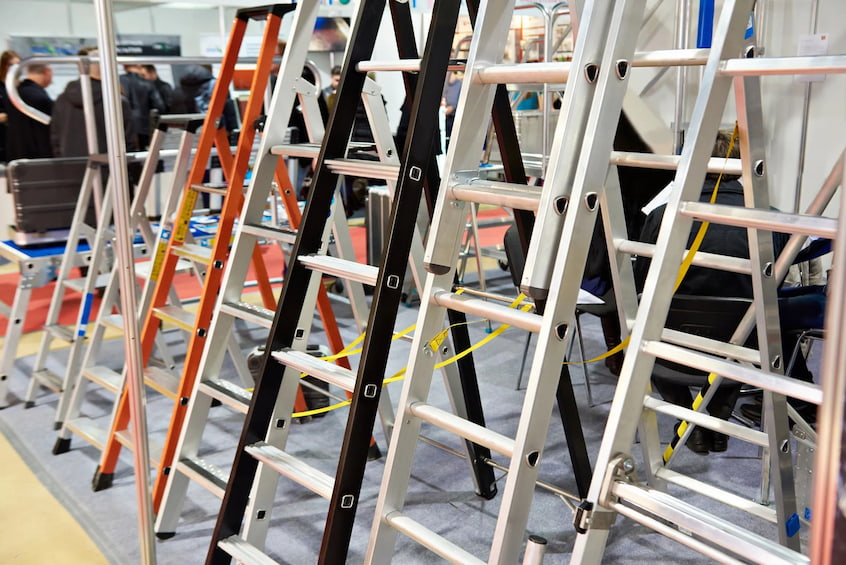
- Ladders – When it comes to traditional vertical access equipment, there are the ladders, with various choices made for the different worksite needs and tasks. Self-supporting A-frame ladders in a range of heights and step setups, high-weight capacity industrial ladders, order and stock picking ladders to streamline transport, mezzanine ladders equipped with handrails for safety, high-stability flat-standing platform ladders, safety step ladders, warehouse ladders with spacious top – there’s no shortage of options. They’re available in light, fibreglass design and sturdy, heavy-duty materials like aluminium.
- Scaffolding – Yet another traditional option, the scaffolding is a convenient solution fit for longer work tasks, higher loads, and complex customisations. Additionally, it’s something that gives you flexibility since it can be fitted with extra safety features, and is available in warehouse, industrial, commercial and some mobile designs.
What Should I Consider When Buying Industrial Access Equipment?
When you get to see the various types and designs of industrial access equipment in Australia, it’s understandable to consider the choice more of a hassle than it should be. Small tools or big machinery, there are some essential factors to look into and evaluate before making the final decision, which are:
- Your specific task – Before moving straight to the height, it’s important to be clear on the task you require the equipment for. Just because two types of equipment are of the same height doesn’t mean they’re equally suitable. Some are better for short duration and some are better for long duration work. For example, ladders are great for short-duration work, as opposed to sturdier access platforms for machinery, maintenance, trucks or warehouse that can handle more; though if it’s long-duration work, then consider scaffolding. The type of scaffolding comes down to the task. Also, how many tools you will be carrying is another decisive factor. With tasks that require varying heights, you may have to resort to motorised designs like boom lifts for ease of movement.
- The needed height – In terms of application, how high is it that the workers have to reach to get the job done properly and safely? What is the location? Keep in mind, platform height is the distance you get from the ground up to the standing deck, i.e. where the feet are, as opposed to the working height which is related to the body reach, i.e. where the hands reach comfortably.
- The horizontal reach – When there’s the need to go over obstacles like moving around machinery, or over certain structures, you would also have to consider equipment that’s meant for horizontal reach and not only vertical reach, in which case knuckle or straight boom lifts would be the go-to choice.
- The ground conditions – Inspecting the conditions prior to the selection and shopping can be of immense help. Frequency of use, obstacles, storage space, available floor space, whether or not the terrain is stable and solid or uneven and rough, and whether it can handle the use of access equipment – these are all important considerations. Moreover, pay attention to flying objects and debris in case of scaffolding or platforms, which would call for additional investment in the right protection with containment solutions like canopies, mesh and nets given that this is among the major hazards in industrial workplaces.
- The use – Specifically, this is related to indoor and outdoor conditions. Not all equipment is created equal. Usually, indoor equipment is safe around the workers, more compact with lighter footprint, and quiet to operate with zero emissions. Outdoor equipment is made for the tough conditions and rough terrains, and comes with more power and longer run time with fuel operated designs like diesel.
- The equipment capacity and size – No matter whether you’re looking to buy safety step ladders or step stools, lifts, ramps or platforms, each option comes with the manufacturer’s specified capacity. The load rating includes the unit weight of the equipment along with the structural capacity, i.e. how much it can handle of the weight of the user(s) plus that of other tools and materials too. It’s essential not to exceed the loads, otherwise there’s an increased risk of accidents. Lastly, don’t forget to check the equipment’s size, with length, weight and height included, to have an idea about how it could fit in your available space before the purchase.
- The equipment material – Yet another aspect related to task and height, the material the access tools or equipment is made from isn’t to be considered an afterthought. The use of proper materials ensures not only that the gear is usable and durable, but overall secure, safe, and made according to the strict standards. Fibreglass is a lightweight choice you can rely on for low-height tasks, whereas aluminium is an all-rounder that comes in handy with many tasks and workplaces. For jobs at bigger heights where there’s more risk of accidents, or bigger loads, there’s need for something sturdy like steel. Check for secure welds and treatments like thick coats of paint to ensure you get the expected durability, with protection against wear and tear as well as rust and corrosion.
- The equipment features – Safety is paramount, and every detail matters in the tools and machines. Go all in on equipment with reliable handrails, toe boards, skid-resistant floors, inward self-closing doors, and reliable, lockable wheels for mobility when needed.
- The manoeuvrability – How easy is the manoeuvrability of the equipment going to be in your workplace? Do you have enough space to use this kind of investment? Evaluating this before the purchase can save you from a lot of headache and unnecessary costs down the road. Compare the machinery specs with the area’s specific dimensions and constraints, if any. This could be issues like clearance height points in the example of ceiling beams, narrow paths, tight corners, and structural blockages like columns.
- The supplier – Where you choose to buy this equipment from is just as important as the above-mentioned factors. Aside from market presence and positive reviews, keep an eye on how much experience they have, how versatile their equipment is and how compliant it is to the strict WHS (Work Health and Safety) laws and Australian Standards (AS/NZS). Should you choose to buy from them, additionally you’d find the prompt delivery helpful, along with site inspection to assess your area for the suitable equipment, and maintenance support services afterwards with adequate spare parts.
- The budget – Budgeting should never come at the expense of quality; what you invest now in quality can more than pay off in the long run in terms of usability, durability and most importantly worker safety. In some cases, if your budget falls short, you can get the most out of the best industrial access equipment in Australia with the hiring alternative, with short-term, long-term and rent-to-buy options backed by service support.
